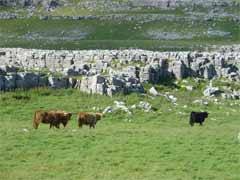
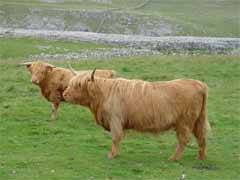
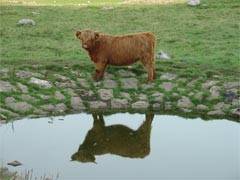
The Highland breed of cattle has a
long and distinguished ancestry not only in its homeland of western
Scotland but also in many far-flung parts of the world.
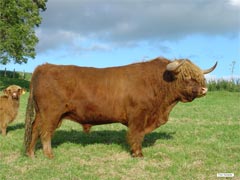
One of Britain's oldest most distinctive, and best known breeds, with
a long thick flowing coat of rich hair and majestic sweeping horns,
the Highlander has remained largely unchanged over the centuries.
Written records go back to the 18th century and the Highland Cattle
Herd Book first published in 1885, lists pedigrees since that time.
New folds, as herds of Highlanders are known, are founded every year
both at home and abroad.
But it is on the vast areas of poor mountain land with high annual rainfall and bitter winds that Highland Cattle thrive and breed where no other cattle could exist.
Making the most of poor forage calving outside and seldom if ever
housed, they make a real economic contribution to hill and upland
areas. |
The breed is exceptionally hardy with
a natural and unique ability to convert poor grazing efficiently.
They are remarkable for their longevity. Many Highland cows continue
to breed to ages in excess of eighteen years having borne fifteen
calves, and they are great mothers.
The Highland breed has been described as charismatic beautiful and noble
and these characteristics come from pure pedigree breeding. Throughout
the centuries the breed has developed and adapted often in adverse
conditions of sparse vegetation and high rainfall until now we undoubtedly
have a very efficient and versatile animal. The majestic appearance
of Highland Cattle will complement any landscape. Colours range from
white through dun, yellow, red, brindle to black.
The versatility of the Highlander led to a great upsurge in exports to the USA, Canada, Australia, New Zealand, Norway, Sweden, Denmark, Finland, Germany, Austria. Holland and South America. Highland Cattle can be found foraging 10,000 feet up in the Andes. |